
Building Bridges
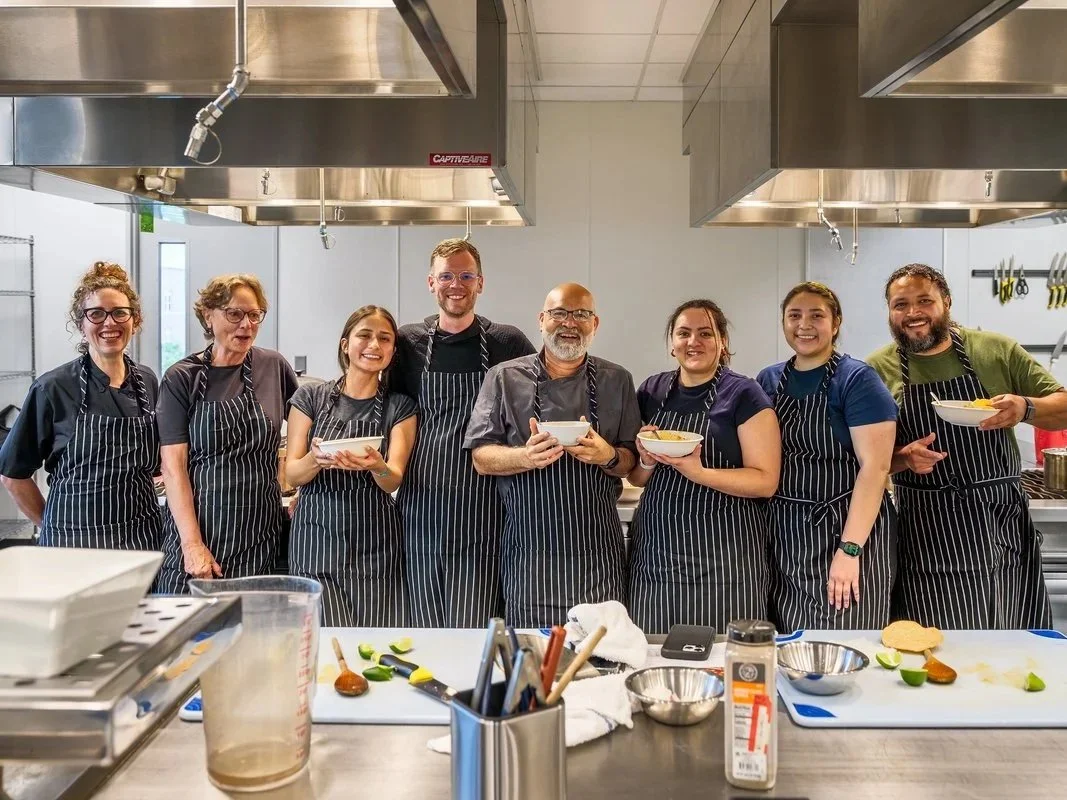
Fayetteville Public Library patrons cook pozole rojo, a traditional Mexican stew, during a Spanish-language Reconquista la Cocina (Conquer the Kitchen) class at the library in May 2025. The library offers the classes periodically as part of its outreach to Spanish-language speakers and Latinos. (Photo courtesy of the Fayetteville Public Library)
También puedes leer este artículo en español aquí.
Public libraries in Arkansas and across the United States provide free access to books, technology, educational programming and other services, ranging from printing and internet access to notarization and meeting space. While libraries in some regions of Latin America may limit borrowing privileges or access due to funding constraints, American public libraries are designed to serve everyone in the community.
Fabio Delgado, a program designer at the Adolphine Fletcher Terry branch of the Central Arkansas Library System, says first-time library patrons may be unaware of how public libraries in the U.S. operate.
“The American library system might be very different than the experience others have. It’s kind of a different concept,” Delgado says.
Delgado, who immigrated from Durango, Mexico, has worked at CALS for more than a decade.
His ability to speak Spanish was one of the attributes that got him his first job in the library system, as libraries across Arkansas, particularly CALS, have started proactively engaging Hispanic residents.
When Nate Coulter was named executive director of CALS in 2016, he began working on the system’s first strategic plan in decades. It identified a need for CALS to engage more with underserved communities, including Hispanic and Black residents of central Arkansas.
“The plan told us to hire two community liaisons,” Coulter recalls.
“They do fabulous work, in two ways that are vital: They go out into the community and identify places people in these populations are — they go and meet people where they are — and they communicate about what the library has to offer. And then they also invite people to tell us what they would like us to do.”
According to CALS records, 4,216 Hispanic and Latino people were reached in 2025 across central Arkansas through community events, and attendance topped 2,500 people at the "Día de Muertos" event in 2024.
Books and More
Libraries are primarily known for loaning out books at no cost, but even rural libraries have expanded their missions. Libraries are often able to offer educational programming, use of and assistance with computers and community events.
At the Fayetteville Public Library, Library Services Director Willow Fitzgibbon has created programs designed to help Spanish-speakers integrate into the community. The library offers English as a second language, GED and ServSafe classes for Spanish-speakers, as well as an online language learning tool called Mango, which offers Spanish and ESL courses.
“We became more intentional about expanding Spanish-language programs and translating materials around 2019 after receiving a grant from Tyson Foods to support that work,” she says. “Demand is modest but growing, and for us, it’s important to offer these services consistently so awareness and participation can build over time.”
The FPL additionally offers Spanish-language books, movies and other materials for check-out and hosts regular cultural events, particularly during Hispanic Heritage Month.
“Our community really responds when we celebrate different cultures,” Fitzgibbon says.
The Arkansas State Library, too, has added materials to better serve Spanish-speakers. Katie Walton oversees the State Library’s Traveler Statewide Digital Resources Program, a collection of online databases, research materials and learning tools, which are available to every public library and library card-holder in Arkansas.
Since August 2024, Traveler resources have included a Spanish-language World Book and the Pronunciator language learning platform.
“Within Pronunciator, there’s also some citizenship practice tests,” she says. “We’ve had World Books for quite a while. … They made a platform for native Spanish-speakers and adults.”
Other databases within the Traveler collection, like science and legal journals, often contain Spanish-language articles.
Like Delgado, Loni Bean is a program designer at CALS’ Dee Brown branch, with the official title of “bilingual library specialist.”
“I connect English-speaking and Spanish-speaking communities,” she says. “It means that connections are happening in our communities; they can come to the library, get education, encouragement and then from there, they can take the skills and cultural knowledge they learned at the library and use it in their neighborhoods, at local businesses. It’s bridge-building.”
CALS offers English and Spanish classes, where non-speakers of either language can learn to communicate with each other. Bean also organizes cultural programming, where residents can learn about elements of Latin culture while connecting with Latinos in attendance.
“It gives people the ability to form bridges outside of the library. I want people to feel equipped to love their neighbors,” Bean says.
A Place for Anyone
Having bilingual staff members has been invaluable for CALS and the FPL because it’s another way to meet members of the community where they are. Bean at CALS says its Hispanic patrons are pioneers in creating cross-cultural connections.
“The Spanish-speaking community in Arkansas is pretty new. In other parts of America, it’s existed for hundreds of years,” she says. “We’re helping create something that’s never existed before, which is the Hispanic Arkansan society.”
At their core, the efforts libraries in Arkansas are taking to engage with Hispanic patrons are part of public libraries’ overall mission — as CALS puts it, “to connect people, nurture potential and grow community.”
“What I tell everybody is, ‘This is your library.’ You need to have the sense that when you go to the public library, you’re going to be welcomed,” Coulter says. “It’s part of the broad notion that America has a tradition of diversity, and the more people you bring into any space from different backgrounds, the better off we are.”